About The Best American Nonrequired Reading Committee

Our selection committee consists of a handful of high school students. One
contingent is in the Bay Area and a second is in Ann Arbor, Michigan.
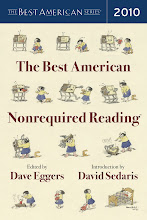
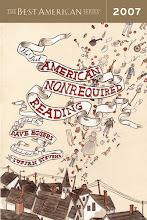
These students help Dave Eggers edit The Best American Nonrequired Reading.
Jesse Nathan is the book's managing editor and Jared Hawkley
is the assistant editor helping out in Michigan.

This collection, published by Houghton-Mifflin, compiles the country's best
fiction, journalism, essays, comics, and humor every year, and introduces
a large readership to dozens of new writers and publications.

The Best American Nonrequired Reading committee -- this year comprising
students from nine different high schools -- meets nearly every week of the
year to read, debate, and compile this offbeat but vital anthology.

This website will update readers on the progress of the 2010 collection
and give you a peek into the process by which the collection is chosen.

The students will blog about what they're reading and listening to and watching,
and we'll transcribe choice moments from the BANR meetings.


Meeting 11/16/2009 (Michigan)

[Transcribed discussion of “Opportunity Knocks,” by Paul Reyes, published in Virginia Quarterly Review.

In this nonfiction investigation of the American housing market, the author follows Max Rameau, a self-appointed “home liberator” who leads a crusade in Miami’s Little Haiti to move homeless families into vacated houses. Usually the result of foreclosures, the abandoned houses are the property of the bank and therefore not legally habitable; yet Max and his followers believe that houses should not be sitting empty when the demand for housing is so high.

After a face-off at the site of a bank seizure between a displaced family, a bank liaison, and a throng of activists and journalists, emotions are mixed from parties involved: the displaced family is relieved but unnerved, Max is satisfied but unfulfilled, the police and the bank are resigned but watchful. The author raises questions about the non-intuitive, non-humanist way that banks manage vacated properties, but also raises questions about the efficacy of street-level, grassroots methods of addressing the problem.]

Michelle: It’s sometimes aggravating to read a piece of journalism that doesn’t follow a logical chain of events, but I felt that by using Max’s story as a foundation, this piece was a lot easier to follow.

Elise: Nothing ever loses points with me if it’s “not journalistic enough.” If it’s too fact-driven, too numbers-driven, I’m not going to get into it, but since we get to see what’s going on in Max’s head, I don’t mind it.

[The students were asked if the author chose an angle that kept their interest.]

Elizabeth: Abandoned houses have a certain natural appeal. The idea of a place that has been vacated and what happens after that is really interesting.

Elise: The first scene where Max and the author are scouting out abandoned houses was a good decision. By approaching the subject from the angle of a person who is passionate about his goal, I was more receptive to the larger story, the reality of the current housing situation.

Emma: I’d never heard of liberating houses; I thought it was an interesting angle to take. It was a good way to point out the flaws of the foreclosing process and the injustice experienced by certain families.

Adam: I thought the events on the last page were the most interesting part of the story. Even though he was worn out from his constant struggling with banks, Max had a vision, a hope, and we got to see that. I wanted to hear what would happen with Max and his houses after the story ended.

[The students were asked if they thought Max’s method of confronting the housing problem was effective.]

Elise: He went into that issue a little. The author spoke about how small of an effort this was, and that even with the community’s support they didn’t seem to have the sway needed to bring about change.

Michelle: There’s this point in the article where the narrator asks the question, “What’s the point?” None of the logic used by the parties involved makes sense. Max sees that, and that’s what he’s acting on.

Meeting 11/9/2009 (Michigan)

[Transcribed discussion of “Enquire Within Upon Everything,” by Richard Powers, published in The Paris Review.

This story is a hypothetical chronicle of a boy’s life in the shadow of the internet age. The protagonist, an unnamed boy, grows up in a time when social interactions are increasingly subsumed by rapidly advancing technologies. At first, many of the technologies the boy uses are familiar to us, but as the story progresses, the ways he exists and interacts with people become more synthetic and strange. Towards the end of his life, the boy ultimately becomes dependent upon his virtual life and social networks. The title of the story refers to a book published in 1856 that was meant to provide encyclopedic information on all aspects of civic life. The precursor to the World Wide Web, “ENQUIRE,” was reportedly named for this book.]

Stephanie: I thought it was cool that the protagonist didn’t have a name, like he could just be anybody. People can project themselves onto him, and that makes the story more real and more true.

Adam: By the end of the story, I had forgotten that it was one big conditional statement. It turns into a projection of how human life could be developing, and raises questions about what’s good or bad about these developments.

Barnaby: I don’t think this story really has anything to do with the future. I’m thinking about the part where the boy learns that another person lived exactly like he did, but one hundred and forty years earlier – it ends up being about the relationship between humankind and technology.

Elise: The ways that humans interact with technology, and the degree to which technology controls our lives – that’s an idea that really seems to interest people right now. This story articulates that concept really well.

[The students were asked to give their thoughts on the emotionless delivery of the story’s major events.]

Elise: He didn’t express emotions to the reader, but the story still evoked an emotional response. I wanted to know “What might he be thinking? What might he be doing?” I felt that he didn’t need to tell us how he felt because the wonder is what keeps readers engaged.

Rachel: I think the writing style works. It just gives us the facts, but that’s exactly what the Internet is – there’s no emotion, only facts.

Adam: When the boy’s son runs away, he describes the event with no emotion. To him, it was just another mechanical development. I thought that was interesting. He didn’t say that his son was disgruntled with technology or with his father – he just decided to leave, to drop off the grid, maybe simply to find out if it was possible.

Meeting 11/3/09 (San Francisco)

[Transcribed discussion of “Held by the Taliban,” by David Rohde, published in the New York Times.

David Rohde is a New York Times journalist. He, his driver, and his interpreter were captured by the Taliban in late 2008 while Rohde was working on a story about Afghanistan. He was held for seven months and ten days before escaping one night by tossing a rope over a wall. This story is his account of what happened, from capture to escape. It was published in five installments in the New York Times.]

Joseph: I loved it. It flows so well. I’ve read similar pieces before, but nothing quite matched this. It gave you such a three-dimensional perspective. You felt for him, but it wasn’t just good guys versus bad guys. He actually ended up having a good relationship with his captors. And the story was so suspenseful!

Gina: The details were amazing. Like the way the Taliban guards gave him a Hannah Montana blanket… that’s such a great detail. It shows the paradox here. They hate America but they have all these American goods.

Dee: I liked the suspensefulness, too. The writing is simple, and then every so often, a detail jumps out. It’s a really good balance. This line was my favorite, from right after he’s captured: “I glanced at the bleak landscape outside — reddish soil and black boulders as far as the eye could see — and feared we would be dead within minutes.”

Joseph: Yeah, it’s suspenseful, but the writer’s not trying to sell you anything. He’s not trying to make you feel one way or another. He’s just telling the story. It’s not flowery.

Anita: I think he did that intentionally. The less flowery a nonfiction piece is, the more you’ll trust the writer. If it were flowery you would start doubting he was telling the truth. This way it’s just the story, with no embellishment.

Meeting 10/27/09 (San Francisco)

[Transcribed discussion of “The Tiger’s Wife,” by Téa Obreht, published in the New Yorker.

In this story, a tiger escapes a zoo in an eastern European city that’s being bombed during World War II. Bewildered, the tiger wanders until settling in a forest outside a provincial village. In the village lives a butcher married to a deaf-mute woman. The woman begins a mysterious, secret relationship with the tiger in her husband’s smokehouse. The villagers learn that the tiger has been creeping down to the smokehouse at night, though they don’t know what the butcher’s wife’s involvement is. The butcher leads a party of three men and two dogs to hunt down the tiger. The hunt is not successful – but the butcher finds some of his meat by where the tiger was spotted resting. The butcher is enraged when he realizes his wife has been feeding the tiger his meat. He beats her and ties her up in the smokehouse. After that no one’s really sure what happens. The butcher disappears, never to be heard from again. According to legend, the butcher’s wife escaped, killed her husband, and fed him to the tiger.]

Tenaya: This story was great because it just has so much stuff in it. It’s got so many layers. There are so many characters and themes.

Nick: I thought it was good, too. I like the imagery. The way the author described the smells and the mountains. And I like the changes in perspective from the tiger to the villagers to the butcher.

Dee: I wanted to keep reading this. I couldn’t put it down. It was weird, but it was really good and I couldn’t stop reading it.

Molly D: At first, I didn’t like it. But it grew on me. I liked that you didn’t really know what happened at the end. I think she probably killed her husband, or the tiger came and got him, or something. It was a good way to end the story, to leave it open-ended.

Will: What I liked about it was the way the story kept evolving and changing. I agree with Molly, the ambiguity at the end was a good move. The author leaves a lot to our imaginations. That ambiguity is satisfying.

Paolo: That’s what I enjoyed the most about it, too. And the way you get all these fragments and then you have to piece them together. I like stories like that. This story is dreamy, and it was fun to read. I like this line a lot: “People must have seen him, but in the wake of the bombardment he was anything but a tiger to them: a joke, an insanity, a religious hallucination.”

[The students were asked if they saw the ending coming.]

Marley: No. I’ve heard of this kind of story before, though. About a wild animal outside a village, scaring the villagers. But even though I feel like this is a familiar kind of story, I didn’t feel like the ending in this case was at all predictable.

Paolo: The crazy thing was the way the author sort of made you think the butcher’s wife might have become part-tiger. That wasn’t something I was expecting. I liked that twist.

Meeting 9/22/09 (San Francisco)

[Transcribed discussion of “The Village of Butterflies,” by Stephanie Dickinson, published in Green Mountains Review.

In this story, an elderly Vietnamese-American woman is stranded in New Orleans just after Hurricane Katrina. While Lake Ponchartrain floods the city, the woman finds herself stuck on the roof of a van otherwise submerged. Hours pass, then days, and she becomes badly dehydrated. Delirious, the woman hallucinates scenes from her younger days when she still lived in Vietnam. This was during the Vietnam War. Her sister’s lover had died in the violence and the old woman re-experiences the day they got the news. She and her sister see a monkey in the treetops and her sister decides this monkey is her lover reincarnated. The sisters are horrified, however, to watch a group of U.S. soldiers shoot it for sport. Then – and the story shifts back to New Orleans – a crate floats up to the woman’s van. In it is a monkey just like the one she and her sister saw killed years ago. The woman makes it her mission, while trying to survive herself, to save this monkey.]

Bianca: This story grabbed me. I liked that it was written from an old woman’s point of view and that there was this connection between where she was and her past, her history.

Nick: For me, this story was about her personal journey. She’s trying to work out some serious issues with her past. And the story is her going on that journey. By helping the monkey she helps her sister. That’s why she sees her sister swimming behind her at the end.

[The woman and the monkey are eventually rescued. At the end of the story, the woman sees the ghost of her long-dead sister swimming behind the rescue boat.]

Joseph: This story kind of sounded like it was a translation. There were all these short sentences, like on page 110: “I have the fish in my fingers. Silvery, darker on its belly. I feel its fright, its terrified eye meeting mine. Its lips are fleshy.” Her descriptiveness is amazing. I know it wasn’t translated, but the short sentences make it sound like it was.

Paolo: The short sentences worked really well, I thought. She’s stranded on this van after a huge disaster and she’s deprived of water. Her thoughts would be short. So having the sentences be really short, too, helped me feel what she was feeling. And I loved all the dreamy parts about life in Vietnam. That added a lot of depth. There’s so much going on. I felt a lot in this story. When they come to rescue her at the end and it looks for a moment like they won’t take the monkey, I was really upset! Then they let her take it along and I thought, YES!

John: I agree. This story touches you on personal level.

Tenaya: It made me really love this old woman.

[The students were asked if they needed to know the history of the Vietnam War to enjoy the story.]

John: Not really. We haven’t studied the Vietnam War much in history class, but I could figure out what was going on in this story without that.

Ellen: I loved this story. And I don’t think you need to know a lot about the Vietnam War, no. This was one of my favorite things we’ve read. I thought the narration went really well. And the short sentences felt honest. There was an honesty to the way she wrote it. It flowed well. There weren’t any tricks in the writing, or long sentences that make your head spin. I enjoyed the way it jumped between New Orleans and Vietnam. It made figuring out what was going on a puzzle, but a fun puzzle. That’s actually what I liked most about it—fitting the pieces together.

Meeting 5/12/09 (San Francisco)

[Transcribed discussion of “Speaking in Tongues,” by Zadie Smith, published in The New York Review of Books and based on a lecture given at the New York Public Library in December 2008.

In this piece, Zadie Smith argues that Obama’s potency as a president lies in his ability to move between seemingly disparate groups of people, to speak in many voices. By this she means, “Obama can do young Jewish male, black old lady from the South Side, white woman from Kansas, Kenyan elders, white Harvard nerds, black Columbia nerds, activist women, churchmen, security guards, and bank tellers.” Because Obama is “a man born and raised between opposing dogmas, between cultures, between voices,” she believes and hopes he will not be able to help “but be aware of the contingency of culture.” Like William Shakespeare, suggests Smith, Obama represents “a mass of contradictory, irresolvable voices that speak truth plurally.”]

Will: This is a great piece because this is one of the big issues that people have had and still have with Obama. Who is he? Even though he’s president, I still don’t really know who he is.

Fiona: I thought the writing was really excellent, too.

[But will anyone, the students were asked, be interested in this piece when the anthology comes out months from now, a year after the election?]

Fiona: I think so. The piece doesn’t start out with Obama, it starts out with her, and with things from her personal life. It only segues into Obama later.

Yael: I agree, and I like this one a lot, too. I don’t even think it’s that much about Obama. Sure, it’s about Obama in lots of ways, but what I mean is I think everybody’s going to find something they love about this. You don’t have to be biracial to relate to this. It’s basically about having different personalities and faces and everyone has that. It makes Obama more understandable, too.

Tanea: It really spoke to the fact that all people are hypocrites in a way. We all want to point out when someone’s not being consistent. At the same time, we aren’t that way ourselves. Everyone has different personalities in different settings.

Adrianne: And it relates to people more on a human level. It’s not such a historical piece. It’s just making one big point, that people have different voices in one self. I think this piece will fit in the book because it will relate to all people. It has universality.

Vicky: It was like listening to someone speak, which I liked. And I liked all the quotes from poems and from Shakespeare.

Eli: She brings her own original analysis to the whole thing, and it’s so impressive. The quote from Keats on page 7—about how Shakespeare was “capable of being in uncertainties, mysteries, doubts, without any irritable reaching after fact and reason”—fits Obama so well.

Molly: I agree with Adrianne. The whole piece has a very human tone. It’s introspective. It’s not really political. It looks more into why people are thinking this way or that about Obama. It gets into the origins of our obsession with him. We’re all trying to figure him out.

Will: Yeah, it seems like you can’t really know who Obama is—and it doesn’t really matter. But I think what Zadie Smith is saying is that he’s kind of the vehicle for all American thought. He can look at every different perspective.

[The students were asked if they noticed themselves, in their own lives, having to move back and forth between different identities.]

Vicky: I have to act differently when I visit family in Mexico. Not in big ways, but it’s different. They treat me differently, too, because I live here.

Yael: Definitely. My mom’s side of the family is really, really religiously Jewish. When we get together with them I have to put on a different face than when it’s just my immediate family. Or maybe it’s just that I say less around that side of the family. Anyway, I’m different around them versus how I am around my friends from suburbia, versus my friends from the city, or my family, or my teachers, or the kids I babysit. In life you have to please different people. And so you have to put on different faces. Zadie Smith is saying that’s not necessarily a bad thing. It’s human.

Meeting 5/5/09 (San Francisco)

[Transcribed discussion of “Wild Berry Blue,” by Rivka Galchen, published in Open City.

In this story, the narrator—a girl in elementary school—falls in love with a cashier at McDonald's called Roy. Every Saturday morning she goes for cookies and milk with her dad. One day she notices Roy working. She describes seeing him for the first time: “In a trembling moment I shift my gaze up to the engraved nametag. There’s a yellow M emblem, then Roy.” She is overcome, she says, by “this beautiful feeling. I haven’t had it about a person before. Not in this way.” She spends the rest of the story trying to catch his eye, trying to make conversation, or pining over him, or searching for the perfect present for him—a wooden puppet from the medieval faire is what she settles on. In the end though, the puppet has a crack. She doesn’t give it to Roy. She realizes things aren’t going to work out. She tries to move on.]

Chloe: I have a weakness for really emotional stories like this, so I loved it. I love stories where it seems like the narrator is talking straight from her consciousness. And there are enough really interesting parts to this piece—the way the little girl introduces people in the story, the way she describes characters, like Roy with that Tattoo, or the ugly puppet stand vendor fiddling with his collar—to keep me really interested the whole time.

Roxie: I like it because she’s so serious. The author is fully in the fifth grade self. I totally hear this little girl talking when I read this story. The author shows us the pure emotion and the outburst of need a little girl can have inside her. I mean, this is the girl’s first love. It was convincing. This is how it felt to be a girl in fifth grade, I think.

Fiona: The writing was good. It all felt really real. That was important, I thought. That it felt real.

Yael: One of the things I thought was very real was the way she has this sense security with her dad. The girl feels dangerous for breaking out and liking this Roy character. That’s such a true, typical feeling for a daughter to have.

[The students were asked what the wooden puppet’s role in the story is.]

Bora: The doll is a physical representation of the mistake that she’s made in loving Roy. Once she notices that there’s a crack on the hand, she doesn’t want it. And she starts to notice that there’s a mistake in the way she’s looking at things with Roy. It can’t work out. The way the author uses a doll to convey this is so well done. I thought the writing in general was excellent. Her description of herself on page 80 reminds me of myself: “I was always that kind of kid who crawled into bed with her parents, who felt safe only with them.” Or her description of the McDonald's scene, it’s amazing the way she captures a child’s perspective. She makes dipping cookies in milk interesting to read about: “Sometimes, dipping my McDonaldland cookies—Fryguy, Grimace—I’d hold a cookie in the milk too long and it would saturate and crumble to the bottom of the carton. There, it was something mealy, vulgar. Horrible. I’d lose my appetite. Though the surface of the milk often remained pristine I could feel the cookie’s presence down below, lurking. Like some ancient bottom-dwelling fish with both eyes on one side of his head.”

Roxie: I also like how, throughout the story, the girl connects things to the future. Like when she says at the end, “I never got over him. I never get over anyone.”

Charley: This girl is such a specific and whole person. She has little tics, like how she likes to wash herself in the sink, that round her out. Her very specific personal preferences like that make her come to life for us as we read.